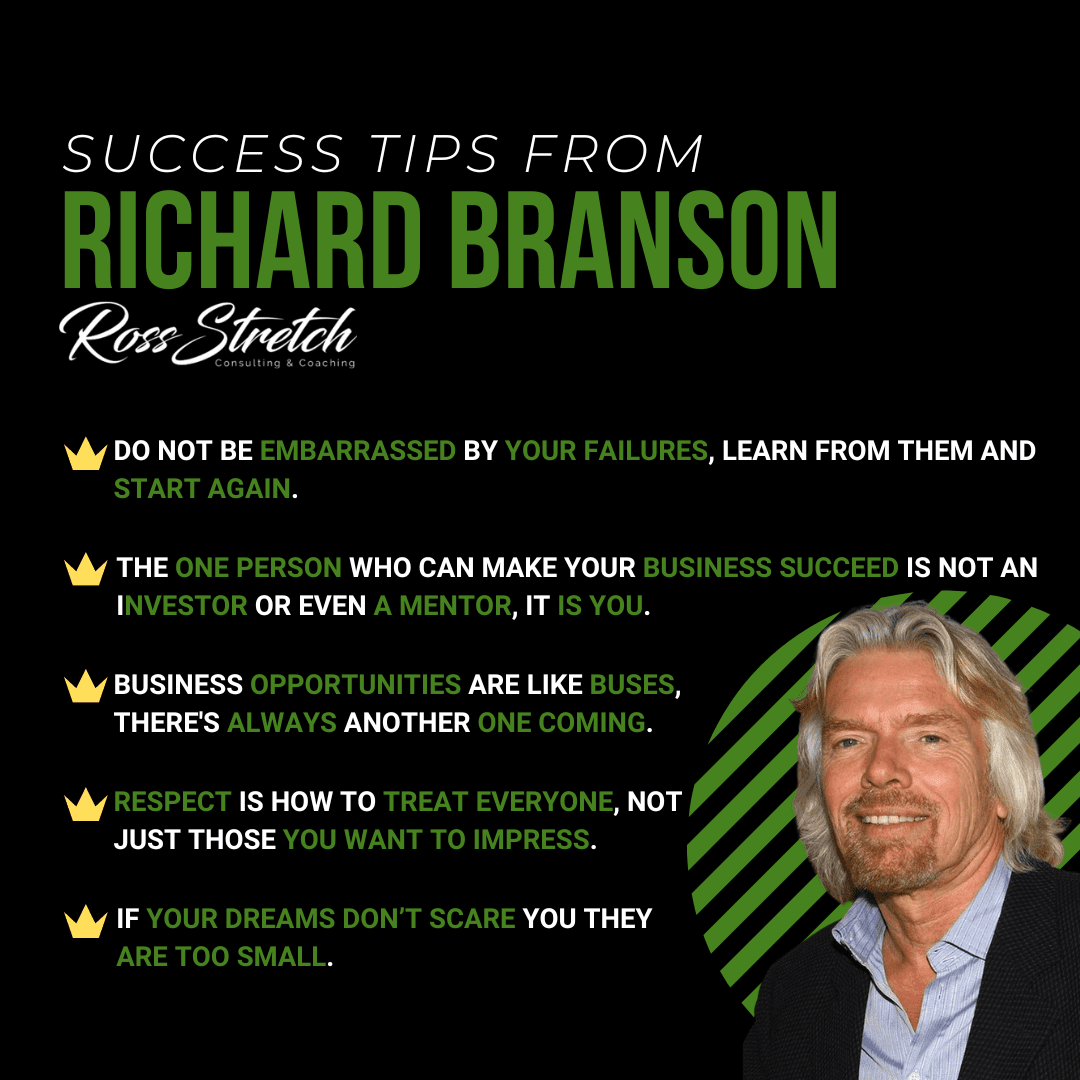
Richard Branson has built more than 400 companies under the Virgin brand, taking on entrenched industries from airlines to telecom to space travel — often with little industry experience and an almost reckless appetite for risk. What makes his story genuinely instructive isn’t just the scale of his success, but the philosophy behind it: a belief that bold action, personal responsibility, and genuine respect for people are more powerful business tools than any spreadsheet or strategy deck. His success tips are drawn from decades of real-world wins and some expensive, instructive failures.
Embrace Failure as a Teacher
“Do not be embarrassed by your failures. Learn from them and start again.” This is one of Branson’s most repeated lessons, and it carries real weight coming from someone who has watched businesses collapse spectacularly. Virgin Cola, Virgin Cars, and Virgin Digital are among the brands that didn’t survive — but each failure generated insights that informed what came next.
The growth mindset that Branson describes isn’t passive acceptance of failure — it’s an active, analytical response. When something doesn’t work, the question isn’t “What’s wrong with me?” but “What exactly went wrong, and what does that teach me about what to do differently?” Entrepreneurs who treat failure as shameful tend to either avoid taking necessary risks or spend years recovering from the psychological damage of a single setback. Those who treat failure as data move faster and with more confidence.
- After any significant setback, conduct a structured debrief: what happened, why, and what you’d change
- Distinguish between avoidable failures (lack of preparation) and instructive ones (reasonable risks that didn’t pay off)
- Keep a record of lessons from failures — reviewing it before major decisions can prevent repeat mistakes
Take Ownership of Your Success
“The one person who can make your business succeed is not an investor or even a mentor. It is you.” Branson is direct on this point: external support — capital, advisors, networks — can accelerate or enable success, but it cannot create it. The foundational driver is the individual’s conviction, persistence, and willingness to do the unglamorous work when it’s needed.
This is particularly important to understand before seeking investment or mentorship. Founders who look to outside validation to confirm they’re on the right path often struggle more than those who operate from a strong internal conviction about the problem they’re solving and why they’re the right person to solve it. Mentors and investors can open doors; only you can walk through them consistently enough to build something lasting.
- Build the habit of accountability — when something goes wrong in your business, start by asking what you could have done differently before looking outward
- Use external advisors for insight, not validation — the decision-making authority stays with you
- Develop a clear personal statement of why you’re building what you’re building; return to it when momentum stalls
Opportunities Are Abundant — Stay Ready
“Business opportunities are like buses. There’s always another one coming.” Branson’s track record of entering unrelated industries — music, aviation, fitness, space — reflects a genuine belief that opportunity is available to those who stay alert and maintain the flexibility to act. Many entrepreneurs fixate on a single idea so intensely that when it doesn’t work, they feel stranded. Branson’s perspective offers a corrective: the absence of one opportunity doesn’t mean the absence of all opportunity.
This doesn’t mean chasing every shiny object. It means developing the discipline of observation — paying attention to underserved markets, listening to complaints people have about existing products and services, and staying connected to enough different industries that you notice patterns before they become obvious. Adaptability is what allows the same entrepreneur to build a record label, an airline, and a rocket company.
- Keep a running list of problems you notice in the world — they’re potential business opportunities
- When a venture doesn’t work, give yourself a defined window to process it, then pivot to what’s next
- Broaden your exposure to different industries through reading, conversations, and events outside your usual circle
Treat Everyone With Respect
“Respect is how to treat everyone, not just those you want to impress.” Branson has been unusually consistent on this point throughout his career, and it’s reflected in Virgin’s reputation as an employer. He famously argues that if you take care of your employees, they’ll take care of your customers — a philosophy that runs counter to the more common approach of prioritizing customer satisfaction above all else.
This principle also applies beyond the workplace. The way you treat a junior employee, a service worker, or a person who can do nothing for you professionally tells people exactly who you are. Branson’s reputation for genuine warmth — not performed warmth, not networking-flavored interest, but actual care — is part of what has made him one of the most recognized entrepreneurs in the world.
- Audit your interactions this week: are you treating support staff and service workers with the same quality of attention as clients and investors?
- Create systems in your business that make it easy for employees to flag problems and be heard
- Remember names, follow up on things people share with you, and make people feel seen — it is more powerful than any marketing strategy
Dream Bigger Than Feels Comfortable
“If your dreams don’t scare you, they are too small.” Branson didn’t set out to build a decent music shop — he set out to build an empire. He didn’t dabble in aviation; he took on British Airways and won. His ambitions have always been outsized, and that audacity has attracted equally ambitious people, investors, and partners.
The psychological function of a genuinely big goal is different from a comfortable one. A big goal recruits your full creativity and problem-solving capacity because you can’t achieve it by doing more of the same. It forces you to think differently, seek unconventional resources, and build unusual coalitions. Manageable goals, by contrast, tend to produce manageable results — and manageable results rarely change much.
- Write down your current biggest goal, then ask: “What would I pursue if I knew this was guaranteed to work?”
- Break the larger vision into 90-day milestones so the scale doesn’t become paralyzing
- Surround yourself with people who expand your sense of what’s possible rather than those who reflexively point out constraints
Key Takeaways
- Failure is a data source, not a verdict — analyze it, extract the lesson, and move forward
- External support can accelerate success, but personal ownership and conviction are the irreplaceable foundation
- Opportunities are continuously available to those who remain observant, flexible, and action-oriented
- Genuine respect for people — not performed respect — is a competitive advantage in business and in life
- Ambitious goals unlock creativity and attract exceptional people; comfortable goals produce predictable results
Resources
- Richard Branson on Virgin.com — essays, business philosophy, and updates from Branson directly
- Losing My Virginity on Amazon — Branson’s autobiography and one of the most candid entrepreneurship books ever written
- Richard Branson on Entrepreneur.com — columns and advice on building and scaling companies
- Branson’s Blog — ongoing writing on leadership, purpose, and entrepreneurship

 Ross Stretch