When Sergey Brin co-founded Google in 1998 alongside Larry Page, the world could not yet comprehend what the internet would become. What Brin understood — and what drove him to build one of the most consequential companies in history — was that innovation is not about incremental improvements to what already exists. It is about asking fundamentally different questions. His journey from a Soviet-born immigrant child to one of the most influential technology entrepreneurs of his generation offers lessons that extend far beyond Silicon Valley. The entrepreneurial mindset Brin embodies is available to anyone willing to adopt it, and the story of Google’s founding is as much a lesson in personal philosophy as it is a business case study.
Build Confidence Through Genuine Competence
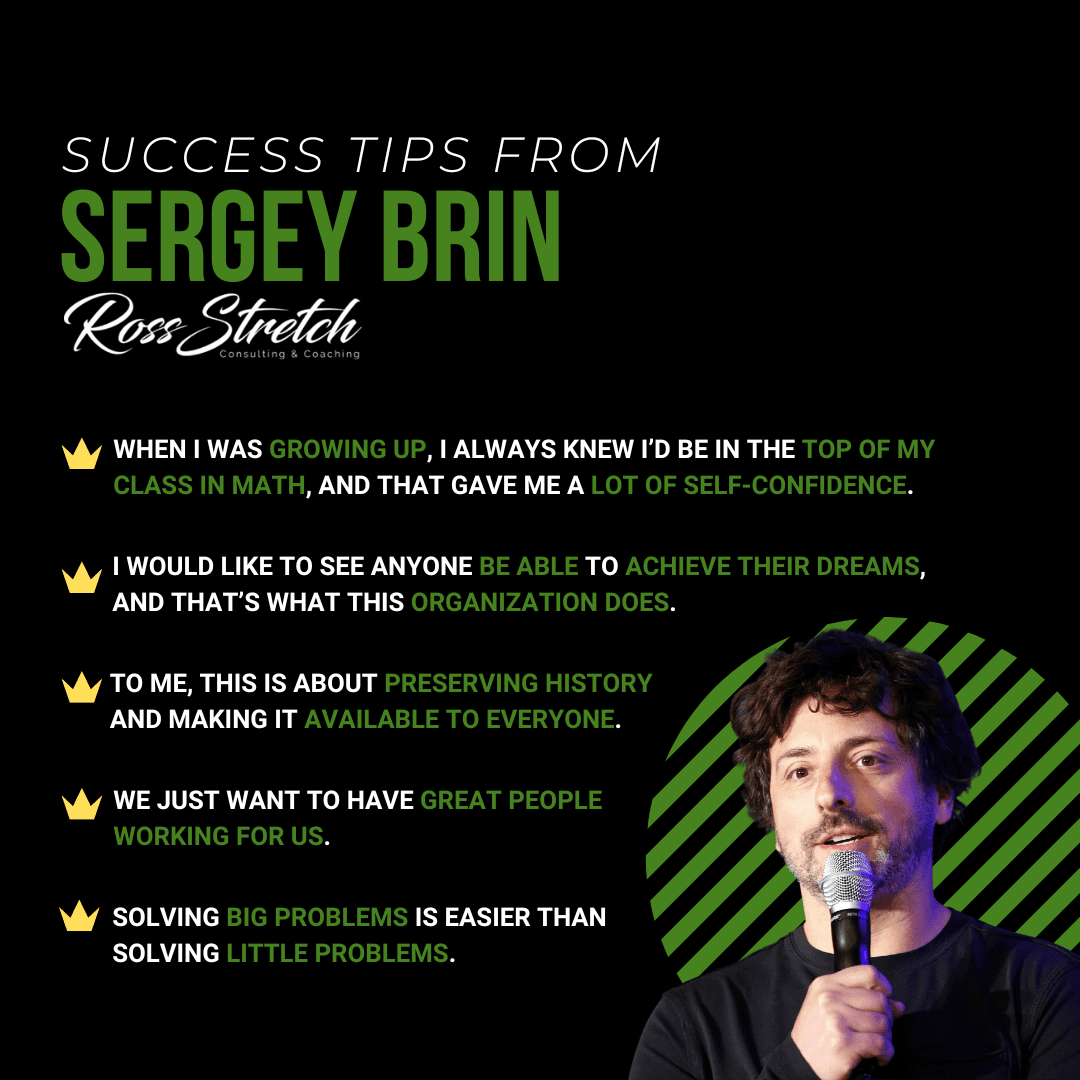
Brin has spoken candidly about his early relationship with confidence: “When I was growing up, I always knew I’d be in the top of my class in math, and that gave me a lot of self-confidence.” This is a notable admission because it reveals something important about how confidence actually works. It does not emerge from generic positive thinking — it grows from domain-specific competence. Brin’s mathematical ability gave him a concrete foundation on which to build a broader belief in his capacity to tackle hard problems.
For entrepreneurs and professionals, this has practical implications. Confidence built on real skill is durable; confidence built on affirmation alone is fragile. The path to unshakeable self-belief runs through genuine mastery of something difficult. That mastery does not have to be mathematics — it can be sales, engineering, writing, negotiation, or any domain that matters to your goals. Invest the time required to become genuinely competent, and confidence will follow as a natural byproduct of demonstrated ability.
- Identify the core skill most critical to your goals and commit to deliberate, sustained practice
- Track your progress objectively — concrete evidence of improvement builds durable confidence
- Separate confidence in your abilities from certainty about outcomes; the former you can build, the latter no one controls
Innovation Is a Mindset, Not a Department
Google’s original mission — to organize the world’s information and make it universally accessible and useful — was extraordinary in its ambition and precision. It did not describe a product. It described a transformation of how human beings relate to knowledge. That kind of thinking — starting from the largest version of the problem and working backward to the solution — is characteristic of how Brin approaches challenges. The audacity of the vision attracted the talent and investment required to execute it.
Brin has said he would like to see anyone be able to achieve their dreams, and that philosophy shaped Google’s organizational culture from the beginning. The company’s famous 20% time policy — allowing engineers to spend a fifth of their work time on personal projects — produced Gmail, Google News, and AdSense, among others. The principle is that creative breakthroughs rarely happen on command; they emerge from cultures that give people freedom and psychological safety to pursue unexpected ideas without fear of failure.
You do not need Google’s resources to apply this principle. Any individual can carve out deliberate time for exploration — reading outside their industry, experimenting with new tools, testing ideas at small scale before committing fully. Innovation is not a talent reserved for geniuses. It is a practice available to anyone who creates the conditions for it.
- Schedule regular time for exploration outside your normal work — reading, experimentation, creative side projects
- Keep a running idea log where no concept is too impractical to record
- Study adjacent industries for solutions that have not yet been applied to your field
Make Knowledge Accessible to Everyone
One of Brin’s driving values is democratization — the belief that information and opportunity should not be available only to the privileged few. “To me, this is about preserving history and making it available to everyone,” he has said. This was not a marketing statement. The Google Books project has digitized millions of books, including rare and out-of-print works previously accessible only to those with access to major research libraries. Google Search itself made expert-level information retrieval available to anyone with an internet connection.
For entrepreneurs and business builders, this principle translates into a powerful competitive and ethical framework simultaneously. Businesses that make information, services, or tools accessible to markets that previously went underserved tend to create enormous value — because they are expanding the size of the market itself rather than fighting over existing customers. Many of the most significant business opportunities in the coming decade will come from applying technology to create access where it currently does not exist — in healthcare, education, financial services, and beyond.
- Ask who currently cannot access your industry’s products or services — and why that barrier exists
- Consider how technology might eliminate barriers of cost, geography, or complexity
- Build with accessibility and inclusion as design goals from the beginning, not as afterthoughts added later
Hire Great People and Create Space for Them to Thrive
Brin has been direct about his talent philosophy: “We just want to have great people working for us.” Simple as it sounds, executing on this principle is one of the hardest and most important things any leader can do. At Google, this has meant hiring people who are not just technically skilled but intellectually curious, collaborative, and capable of operating in ambiguity — traits that cannot be measured by credentials alone and that require thoughtful interviewing to surface.
The critical follow-through — which separates good intentions from truly great teams — is creating an environment where talented people have the autonomy and resources to do their best work. Hiring great people and then micromanaging them is one of the most wasteful patterns in organizational life. Talent walks out of environments where it is not trusted, challenged, or heard. Brin’s consistent emphasis on team quality reflects an understanding that no individual, no matter how brilliant, builds something great alone.
- Define what great looks like for your specific context — skill requirements, cultural fit, and growth orientation differ in every organization
- Invest in retention as seriously as recruitment; losing exceptional people is far more costly than the effort of keeping them
- Give talented team members real problems to solve and genuine ownership over outcomes, not just tasks
Think Big: Solve the Problems That Actually Matter
Perhaps the most counterintuitive of Brin’s insights is this: “Solving big problems is easier than solving little problems.” This runs against conventional wisdom, which suggests you should start small, stay practical, and manage risk conservatively. But Brin’s point is about motivation, talent attraction, and sustained commitment. Big, ambitious problems draw the best people. They generate the kind of passion and dedication that sustains teams through the years of difficulty that any genuine breakthrough requires.
Small problems, by contrast, attract modest effort. The stakes are low, the upside is limited, and the most talented contributors often go elsewhere because the work does not feel meaningful enough to warrant their best. This does not mean every business must operate at Google’s scale. It means that within whatever domain you occupy, you should be aiming at the most meaningful version of the problem — not the easiest version. The harder and more important the problem you solve, the more valuable and defensible the solution becomes.
- Define the most ambitious version of your goal — then honestly assess what pursuing it seriously would require
- Recruit collaborators by leading with the significance of the problem, not just the compensation
- Expect that significant problems take longer and require more iteration than small ones — build your timeline and resources accordingly
Conclusion
Sergey Brin’s success is not the result of luck or timing alone. It is the product of a clearly articulated philosophy: build confidence through competence, create conditions for innovation, make knowledge available to all, hire and trust exceptional people, and tackle problems at a scale that matters. These principles are not proprietary to Google or to its founders. They are available to any entrepreneur, professional, or individual willing to apply them with consistency and conviction. The question is not whether you can think this way — it is whether you will choose to start.
Resources

 Ross Stretch