Few investors in history have demonstrated the sustained success of Warren Buffett. Over more than six decades of active investing, Buffett transformed Berkshire Hathaway from a struggling textile company into one of the most valuable conglomerates on earth. His approach — rooted in value investing, deep business analysis, and an unwavering commitment to ethical conduct — remains as relevant for individual investors and entrepreneurs today as when he started. These are not abstract principles. They are practical guidelines that apply to personal finance, business decisions, and daily life with equal force.
Reputation Takes Decades to Build — and Minutes to Destroy
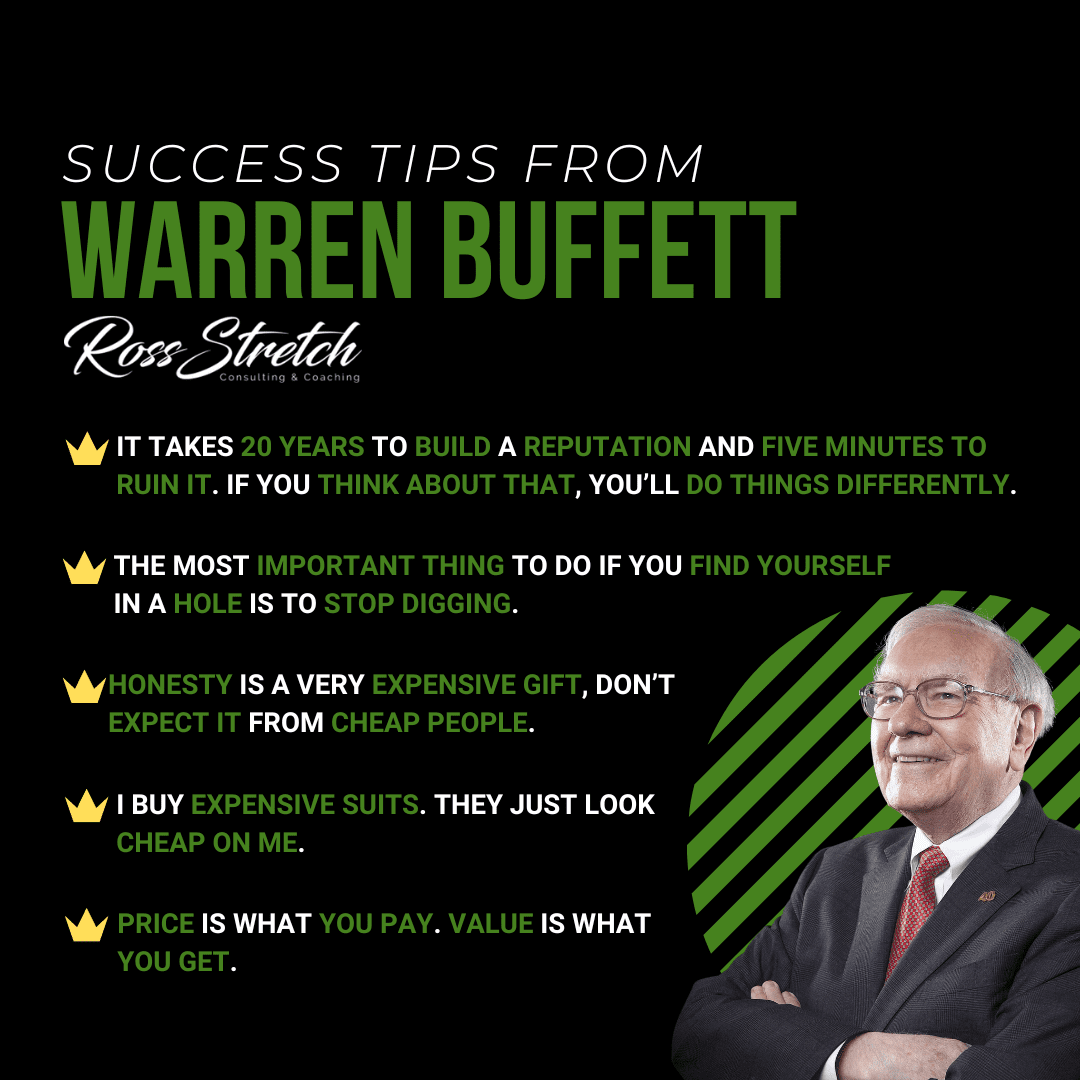
One of Buffett’s most quoted observations is this: “It takes 20 years to build a reputation and five minutes to ruin it. If you think about that, you’ll do things differently.” This is not merely a warning about scandal. It is a principle about how trust operates as both a personal and financial asset. In business, reputation is the currency that opens doors, enables partnerships, and attracts talent. Once damaged, it is extraordinarily difficult to rebuild.
Buffett has applied this principle rigorously at Berkshire Hathaway. In his annual shareholder letters, he consistently emphasizes that he would rather lose money than lose the company’s reputation. This long-term perspective — treating reputation as a core asset rather than an afterthought — separates great leaders from merely successful ones. For individuals, the lesson is equally clear: the shortcuts that seem minor in the moment often carry long-term costs that far exceed any short-term gains.
- Make decisions as though your actions will be public knowledge — because eventually, they often are
- Prioritize long-term relationships over short-term transactional wins
- Deliver on commitments consistently — reliability compounds into reputation over years
- Act with integrity even when the easier path seems harmless
Price Is What You Pay — Value Is What You Get
This distinction between price and value is the foundation of Buffett’s entire investment philosophy, inherited and refined from his mentor Benjamin Graham. A stock’s price is what the market is currently willing to pay. Its value is the discounted sum of all future cash flows the underlying business will generate. The two are often very different, and the gap between them is where opportunity lives.
Buffett built his fortune by identifying businesses trading below their intrinsic value — companies with durable competitive advantages, predictable earnings, and honest management — and holding them patiently while the market eventually recognized their worth. He famously avoids chasing fashionable stocks and has largely stayed away from sectors he does not understand deeply. This discipline has kept him out of speculative bubbles and positioned him to buy aggressively when markets panic and prices fall well below true value.
The principle extends beyond investing. In any area of life, distinguishing between what something costs and what it is actually worth is a form of critical thinking that leads to better decisions — whether you are evaluating a business acquisition, a hiring decision, or a major purchase.
- Research the intrinsic value of investments before buying based on price momentum alone
- Focus on businesses with strong, durable competitive advantages — what Buffett calls economic moats
- Practice patience; the market eventually rewards accurate valuation, but not always on your timeline
When You Are in a Hole, Stop Digging
Buffett’s advice about holes is deceptively simple: “The most important thing to do if you find yourself in a hole is to stop digging.” The principle addresses one of the most common and costly errors in investing and business — the escalation of commitment, sometimes called the sunk cost fallacy. People continue pouring resources into a failing position because they are emotionally attached to being right or unwilling to realize a loss.
Buffett has spoken candidly about his own mistakes — including his years-long reluctance to exit the original Berkshire textile operations, and his investment in Dexter Shoes, which he described as the worst deal he ever made. What distinguishes him is his willingness to acknowledge those errors publicly and course-correct without ego. The ability to recognize a bad decision, cut losses, and redirect resources is a critical discipline that saves both money and time — and it requires overcoming powerful psychological resistance.
- Review investments and projects regularly for positions that no longer meet your original thesis
- Distinguish between temporary adversity — worth enduring — and fundamental error, worth cutting
- Define exit criteria before entering positions so emotion does not cloud judgment when things go wrong
Honesty and Integrity Are Non-Negotiable
Buffett is direct about the cost of associating with dishonest people: “Honesty is a very expensive gift, don’t expect it from cheap people.” This goes beyond avoiding fraud or legal risk. It is about the quality of information and relationships that form the foundation of sound decisions. When you partner with, invest in, or hire people who shade the truth, you are operating on corrupted data — and bad data produces bad outcomes regardless of how sophisticated your analysis is.
One of Buffett’s key criteria when evaluating businesses is the integrity of the management team. He has said repeatedly that he looks for managers who behave as if they own the entire company and treat shareholders as partners. Managers with that orientation report bad news as promptly as good news, make conservative accounting decisions, and resist the temptation to manage earnings to meet short-term expectations. That kind of honesty is rare, and when Buffett finds it, he holds on tightly.
- Assess integrity before intelligence — smart dishonest people are far more dangerous than honest people who make honest mistakes
- Create environments where people feel safe surfacing problems without fear of penalty
- Model the transparency you want to see from the people around you
Live Below Your Means — Regardless of Your Net Worth
Buffett’s lighthearted remark — “I buy expensive suits. They just look cheap on me.” — reveals something important about his relationship with money. Despite being one of the wealthiest people on earth, he still lives in the Omaha house he purchased in 1958 for $31,500, drives modest cars, and maintains famously frugal spending habits. This is not eccentricity. It is a principled commitment to frugality that has compounded dramatically over decades.
The logic is straightforward: every dollar you do not spend on lifestyle is a dollar available to invest and compound. Early in his career, Buffett was intensely aware of the opportunity cost of consumption. He treated present spending as foregone future wealth — a mindset that anyone can apply regardless of income level. The gap between what you earn and what you spend is not just your savings rate. It is your financial freedom rate, the speed at which you are building independence from the need to trade your time for money.
- Track your actual savings rate, not just your gross income or investment returns
- Delay major lifestyle upgrades until your investment income can comfortably support them
- Focus spending on experiences and relationships that create lasting value, not status symbols
Conclusion
Warren Buffett’s success principles are not complicated — but they require the discipline to apply them consistently in a world that rewards speed, novelty, and short-term thinking. Building reputation, distinguishing price from value, cutting losses without ego, demanding honesty, and living below your means are habits that compound over time just as interest does. The earlier you adopt them, the more powerful their cumulative effect. Buffett’s greatest investment has always been in the principles that guide his decisions — and that is an investment available to anyone willing to make it.
Resources


 Ross Stretch