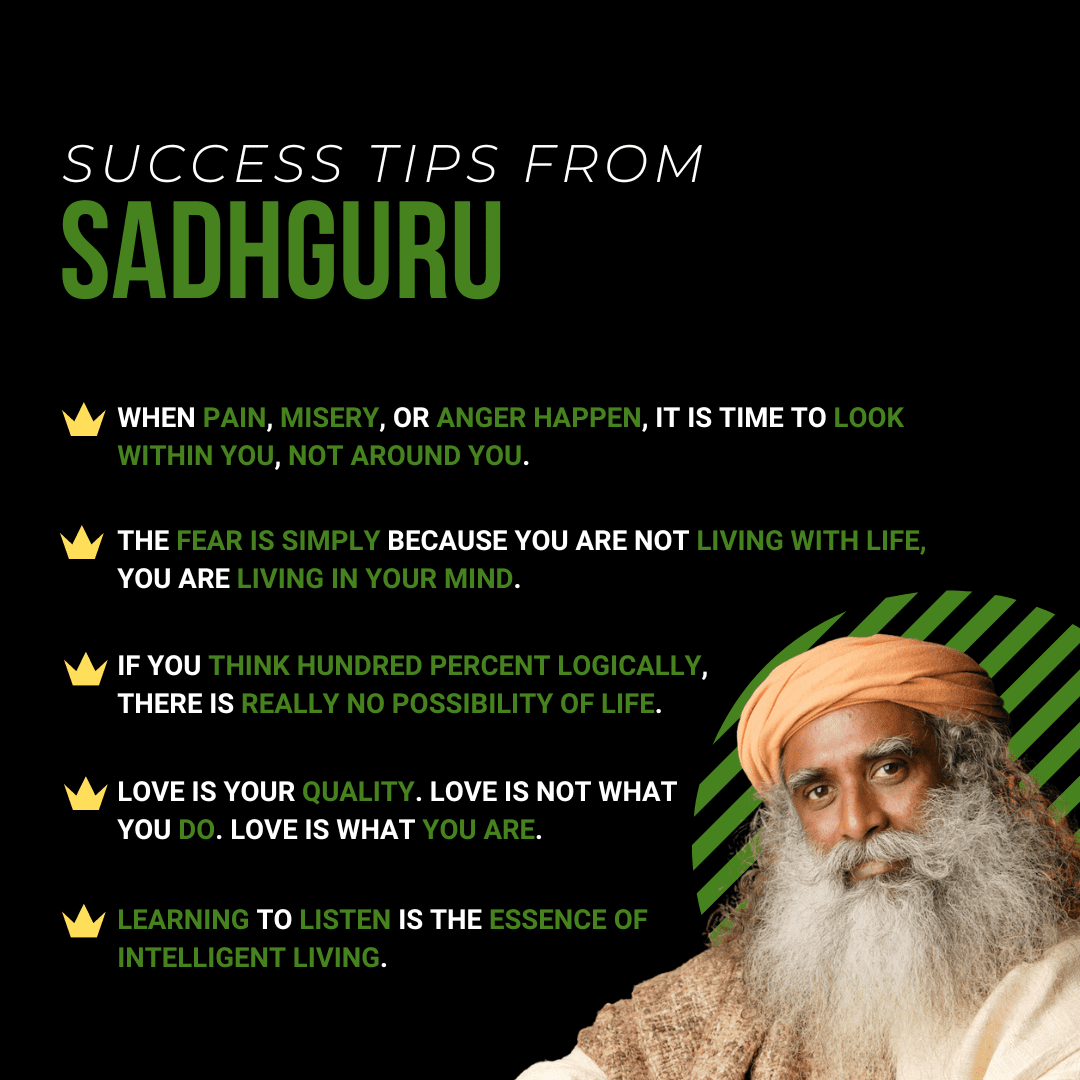
Sadhguru — born Jaggi Vasudev — is one of the most influential spiritual teachers of the modern era, the founder of the Isha Foundation, and a sought-after voice at global forums including Davos and the United Nations. What distinguishes his philosophy is its radical practicality: his insights aren’t abstract spiritual concepts but actionable principles for living with greater clarity, presence, and purpose. In this article, we explore five of his most powerful teachings and how to integrate them into the demands of a modern professional and personal life.
1. When Pain, Misery, or Anger Happen, It Is Time to Look Within You, Not Around You
Emotional Responsibility Is the Foundation of Real Power
This teaching cuts directly against one of the most common human impulses: when something hurts, we look for an external cause. A difficult colleague, an unfair market, an unsupportive environment — the external world offers an endless supply of targets for our emotional distress. But Sadhguru’s insight is that assigning blame externally doesn’t resolve the suffering — it just relocates it. The emotions you experience are generated by your own nervous system in response to circumstances, not caused by the circumstances themselves.
- Actionable Tip: The next time you feel frustration or anger at work, pause before reacting. Ask: “What belief or expectation of mine is being violated here?” The answer almost always reveals something you can actually work with — unlike blaming someone else, which leaves you powerless.
- Why It Works: Cognitive behavioral therapy — one of the most evidence-backed psychological frameworks in existence — is built on exactly this premise: that our emotional responses are produced by our interpretations of events, not the events themselves. Changing the interpretation changes the experience.
Pro Tip:
Build a brief daily reflection practice — five to ten minutes of journaling or quiet contemplation where you review the emotional texture of your day. Not to analyze or judge yourself, but simply to observe. Over time, this builds what psychologists call “emotional granularity” — the ability to identify and work with specific emotions rather than being swept by them indiscriminately.
2. The Fear Is Simply Because You Are Not Living Life, You Are Living Your Mind
Most Anxiety Is a Projection, Not a Reality
Sadhguru draws a critical distinction between experiencing life as it actually is versus experiencing the mind’s narrative about life — its projections of what might go wrong, what others think, and what the future holds. The vast majority of anxiety doesn’t arise from actual present danger but from mental simulations of possible futures that may never materialize. This is not mystical observation — neuroscience research confirms that the brain’s default mode network generates most of its activity through mental time travel: ruminating on the past and worrying about futures that haven’t happened.
- Actionable Tip: When anxiety arises, ask: “Is this a present-moment problem or a mental simulation?” If you cannot take any concrete action right now to address it, the anxiety is hypothetical. Redirect your attention to whatever is actually in front of you — your current task, your current conversation, your current environment.
- Why It Works: Mindfulness-based cognitive therapy, developed at Oxford University and validated in over a hundred clinical trials, is built on training exactly this capacity — the ability to observe mental content without being controlled by it — and consistently reduces anxiety, depression, and burnout in working adults.
Pro Tip:
Sadhguru recommends treating every activity — even mundane ones like eating or walking — as worthy of full attention. This isn’t just spiritual advice; it’s a practical antidote to the constant partial attention that characterizes modern professional life and simultaneously degrades both performance and well-being.
3. If You Think Hundred Percent Logically, There Is Really No Possibility of Life
Integrate Intuition to Make Decisions Logic Alone Cannot Reach
This is Sadhguru’s challenge to an exclusively analytical approach to life and work. Logic is an essential tool — but it operates on the data already available to your conscious mind. Intuition, by contrast, draws on the vast reservoir of unconscious pattern recognition built from years of accumulated experience. The best business decisions, creative breakthroughs, and human judgments often originate from an integration of both: the logical framework that structures the problem, and the intuitive insight that resolves it.
- Actionable Tip: After completing a logical analysis of a major decision, set it aside for 24 hours and notice what your gut is telling you. If the intuitive signal strongly contradicts the analytical conclusion, investigate the gap — your intuition may be detecting something your analysis missed.
- Why It Works: Nobel laureate Daniel Kahneman’s work distinguishes between fast, intuitive thinking and slow, analytical thinking. The highest-quality decisions consistently involve both — neither pure gut reaction nor pure analysis alone produces optimal outcomes across complex, uncertain situations.
Pro Tip:
Create deliberate space for non-analytical thinking — walks without podcasts, meals without screens, mornings without immediate email. Many breakthrough insights emerge not during focused analytical work but in the quiet intervals when the mind is free to make connections across its full store of knowledge and experience.
4. Love Is Your Quality. Love Is Not What You Do, Love Is What You Are
Cultivating Generosity as a Professional Superpower
Sadhguru’s reframing of love — from an occasional action to a fundamental orientation — has profound professional implications. When you approach your work, your colleagues, your clients, and your community from a place of genuine care and generosity, the quality of your relationships and your output fundamentally changes. The most effective leaders, the most trusted advisors, and the most loyal teams are built on exactly this quality — not manufactured warmth, but authentic interest in and concern for the people around them.
- Actionable Tip: In your next team meeting or client interaction, focus your full attention on understanding what the other person actually needs — not what you assume they need, and not on what you want to get from the interaction. This single shift in orientation transforms the quality of every professional relationship over time.
- Why It Works: Research by Adam Grant at Wharton Business School demonstrates that “givers” — people whose default orientation is to contribute value to others — consistently outperform “takers” in long-term career outcomes, despite sometimes being outpaced in the short term. Generosity is strategically sound, not just morally admirable.
Pro Tip:
Extend this principle to your relationship with your work itself. When you approach a project with genuine care — not just competence — the output is qualitatively different. Sadhguru argues that love as an orientation produces not just better relationships but better work: more creative, more thorough, and more genuinely useful to the people it’s meant to serve.
5. Learning to Listen Is the Essence of Intelligent Living
The Rarest and Most Valuable Communication Skill You Can Develop
In a world of constant broadcasting — where everyone is publishing, posting, and performing — the ability to truly listen has become extraordinarily rare and correspondingly valuable. Sadhguru’s point is that most people don’t listen to understand; they listen to respond. They’re already formulating their next sentence while the other person is still speaking, which means they’re capturing perhaps 40% of what’s actually being communicated. The professionals who develop genuine listening as a discipline gain access to information, insight, and trust that perpetually eludes their less attentive peers.
- Actionable Tip: In your next significant conversation, make a conscious commitment to ask two follow-up questions before offering any opinion or solution. This single practice forces genuine engagement with what the other person is actually saying, rather than waiting for a gap to insert your own perspective.
- Why It Works: Research by Zenger and Folkman published in Harvard Business Review found that the most effective leaders were rated by subordinates not as the best speakers but as the best listeners. Listening creates trust, uncovers real needs, and builds the relational capital that makes everything else in your professional life easier.
Pro Tip:
Practice listening “with your entire being” — attending not just to the words being spoken, but to tone, body language, and what is being left unsaid. The most important information in any conversation is often not in what people explicitly state, but in the hesitations, qualifications, and emotions that accompany their words.
Conclusion
Sadhguru’s teachings occupy a unique space — simultaneously ancient in origin and urgently relevant to the challenges of modern professional life. His five core principles — taking responsibility for your inner state, living in the present rather than your mental projections, integrating logic with intuition, leading with love and generosity, and cultivating deep listening — are not abstract ideals. Applied consistently, they produce measurable improvements in performance, relationships, and well-being.
The most important insight is this: the inner work and the outer work are not separate. How you relate to your own mind, your own emotions, and the people around you determines the quality of everything you build. Start with one principle. Practice it deliberately for thirty days. The results will make the case better than any philosophy can.
Resources

 Ross Stretch