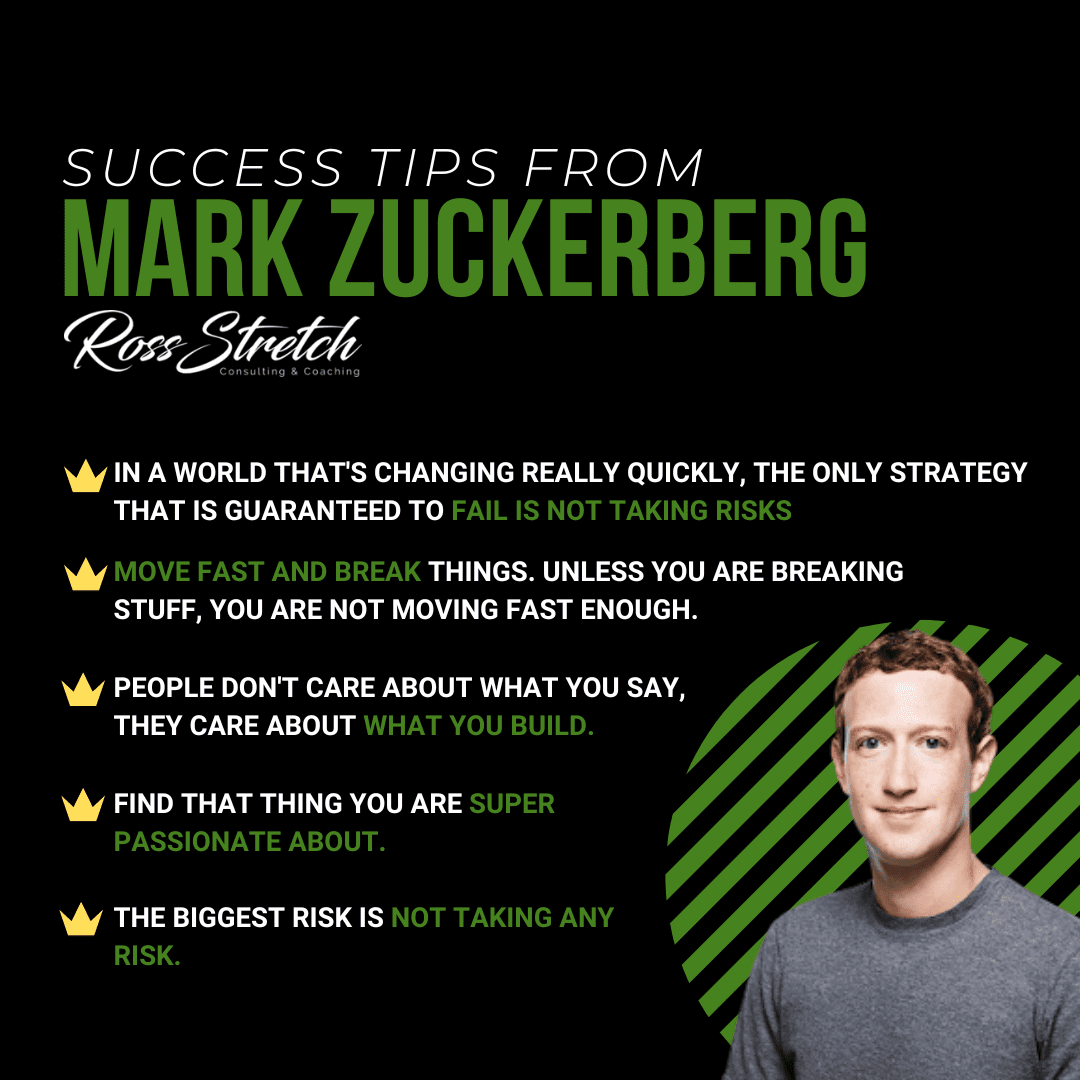
Mark Zuckerberg, the co-founder and CEO of Meta (formerly Facebook), has become synonymous with bold innovation, calculated risk-taking, and a relentless drive to build products that reshape the world. His journey from a Harvard dorm room to leading a company valued at over $1 trillion is a masterclass in entrepreneurial thinking. In this article, we explore five of Zuckerberg’s most powerful success principles — the mindsets that drove him to build one of the most influential technology companies in history — and how ambitious professionals can apply them to their own careers and ventures.
1. In a World That’s Changing Really Quickly, the Only Strategy That Is Guaranteed to Fail Is Not Taking Risks
Calculated Risk Is the Price of Admission for Success
Zuckerberg launched Facebook at 19 and turned down a $1 billion acquisition offer from Yahoo in 2006 — a decision widely mocked at the time that proved to be one of the shrewdest in tech history. His philosophy is clear: in a fast-moving world, the greatest danger isn’t failure — it’s becoming irrelevant by playing it safe. Every major breakthrough in business history was preceded by someone willing to act before the outcome was certain.
- Actionable Tip: Identify one decision you’ve been delaying because of fear of failure. Set a 48-hour deadline to commit to a direction and take the first concrete step.
- Why It Works: Psychological research shows that action-oriented individuals develop resilience faster than those who avoid risk — each attempt, regardless of outcome, builds the neural pathways for better future decision-making.
Pro Tip:
Use the “regret minimization framework” — a strategy popularized by Jeff Bezos but aligned with Zuckerberg’s thinking. Ask yourself: “When I’m 80 years old, will I regret not trying this?” If the answer is yes, act. The regret of inaction consistently outweighs the regret of a failed attempt.
2. Move Fast and Break Things — Unless You Are Breaking Stuff, You Are Not Moving Fast Enough
Speed and Iteration Beat Perfection Every Time
This became Facebook’s unofficial mantra for years, and while Zuckerberg later refined it to “move fast with stable infrastructure,” the core principle remains: speed of execution is a competitive advantage. Companies that launch, learn, and iterate outpace those that wait for perfect conditions that never arrive. In Facebook’s early days, engineers shipped multiple code updates per day — a cadence that allowed the platform to outmaneuver rivals who spent months planning releases.
- Actionable Tip: Apply the 80% rule — if your plan, product, or pitch is 80% ready, ship it. Get real-world feedback instead of polishing in a vacuum.
- Why It Works: The lean startup methodology, championed by Eric Ries and validated by thousands of companies, proves that market feedback is worth more than months of internal refinement. Real users reveal problems you’d never anticipate alone.
Pro Tip:
Build “failure budgets” into your projects — explicitly allocate time and resources for things to go wrong and require iteration. Teams that plan for experimentation rather than perfection move faster, adapt quicker, and ultimately build better products than those paralyzed by the fear of imperfection.
3. People Don’t Care About What You Say, They Care About What You Build
Execution Is the Only Currency That Counts
In a world saturated with pitches, plans, and proclamations, results are the only differentiator that matters. Zuckerberg’s philosophy is rooted in a builder’s mentality: talk is cheap, execution is everything. Facebook didn’t win because Zuckerberg gave better speeches than competitors — it won because the platform was better built, faster iterated, and more focused on delivering real value to its users. Your credibility, reputation, and income are all downstream from what you actually create.
- Actionable Tip: Before your next meeting or pitch, ask yourself: “What have I built or shipped since we last spoke?” If the answer is nothing, spend less time talking and more time executing.
- Why It Works: Trust is built through demonstrated competence, not declared intention. People follow, hire, and invest in builders — those who consistently deliver on their promises over time.
Pro Tip:
Create a “shipped log” — a running document of everything you’ve completed, launched, or delivered each week. Beyond tracking progress, it rewires your focus from planning mode to execution mode, and gives you concrete proof of impact when opportunities arise.
4. Find That Thing You Are Super Passionate About
Passion Is the Fuel That Sustains You Through the Hard Parts
Zuckerberg has repeatedly stated that he never started Facebook to build a company — he built it because he was genuinely passionate about connecting people. That distinction matters enormously. Entrepreneurs and professionals driven by intrinsic passion have a structural advantage over those motivated purely by profit: they persist longer, think more creatively, and attract others who share their vision. Passion isn’t a soft concept — it’s a practical edge that compounds over years.
- Actionable Tip: Write down three problems in the world that genuinely frustrate or fascinate you. Your best career or business opportunities live at the intersection of those problems and your existing skills.
- Why It Works: Research from Gallup’s global engagement surveys consistently shows that intrinsic motivation — doing work you find inherently meaningful — produces higher performance, greater resilience, and longer career longevity than extrinsic motivation alone.
Pro Tip:
Don’t wait to “find” your passion — it’s often discovered through doing, not thinking. Start working on problems that matter to you, even at a small scale. Passion deepens with competence; the more skilled you become at something meaningful, the more motivated you’ll be to push further.
5. The Biggest Risk Is Not Taking Any Risk
Comfort Is the Real Enemy of Progress
This principle is Zuckerberg’s most counterintuitive insight: safety is not actually safe. In a world where industries are being disrupted, AI is reshaping entire professions, and the pace of change is accelerating, standing still is one of the most dangerous positions you can occupy. The people who achieve extraordinary results do so not by avoiding failure, but by treating failure as tuition — the cost of acquiring knowledge and capability that cannot be gained any other way.
- Actionable Tip: Identify one area of your career or business where you’ve been playing it safe. Design a “minimum viable risk” — the smallest action you could take this week that would move you into uncomfortable but growth-producing territory.
- Why It Works: Carol Dweck’s foundational research on growth mindset demonstrates that individuals who embrace challenges and view failures as learning opportunities outperform their peers across virtually every measurable domain — from academic performance to business leadership.
Pro Tip:
Reframe risk as an investment with variable returns, not a binary win/lose proposition. Even failed ventures teach you pattern recognition, resilience, and domain knowledge that make your next attempt significantly more likely to succeed. Zuckerberg’s first social project at Harvard — Facemash — got him in trouble with university administrators. Without it, Facebook might never have existed.
Conclusion
Mark Zuckerberg’s success didn’t emerge from perfect circumstances or a flawless strategy — it came from an unwavering commitment to taking risks, executing fast, building real things, and staying passionately focused on what mattered most. These aren’t principles reserved for Silicon Valley billionaires. They’re accessible frameworks that any ambitious professional can apply today, regardless of industry or experience level.
The common thread running through every principle Zuckerberg espouses is a bias toward action. Start before you’re ready. Build before you’re certain. Risk before you’re comfortable. The world rewards those who create — and the only way to become a creator is to begin.
Resources

 Ross Stretch