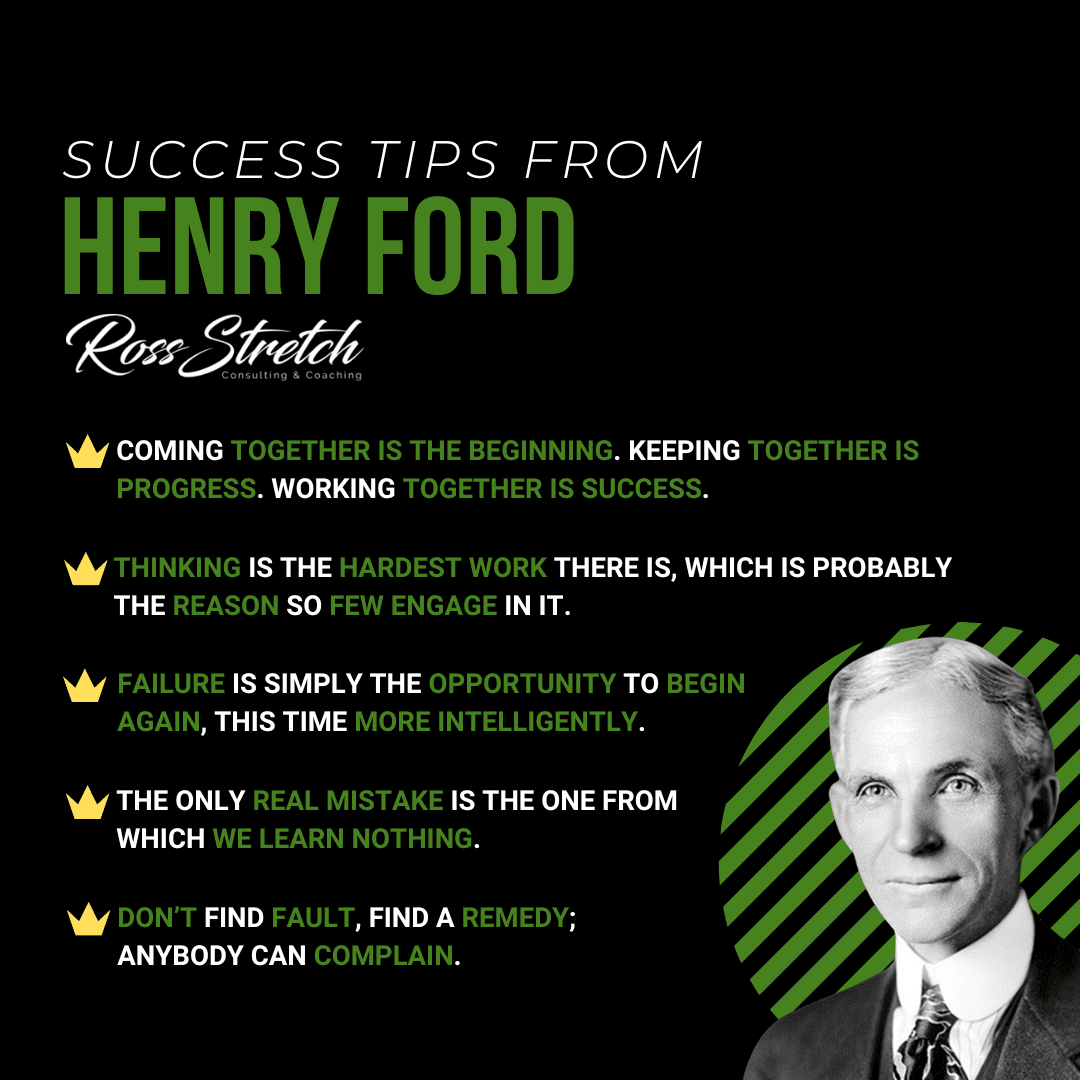
Henry Ford, the iconic industrialist and founder of Ford Motor Company, was not only a pioneer in the automotive industry — he was one of history’s most quotable and practically minded thinkers on the subjects of teamwork, resilience, and problem-solving. Ford built the world’s largest automobile manufacturer from nothing, revolutionized global manufacturing with the moving assembly line, and paid his workers five dollars a day when competitors paid half that — understanding intuitively that the prosperity of his workforce was inseparable from the prosperity of his enterprise. His principles are not relics of a bygone industrial era. They are operational frameworks for achievement that become more relevant every year as complexity increases and distractions multiply.
Why Ford’s Philosophy Still Applies
Ford’s success was not accidental, and it wasn’t purely the product of mechanical genius. What separated Ford from his contemporaries was a set of deeply held beliefs about human potential, collective effort, and the nature of progress. In a time when most industrialists treated workers as interchangeable components, Ford saw them as partners in a shared enterprise — and the results were undeniable. By 1918, half of all cars in America were Ford Model T’s. By the mid-1920s, Ford was producing more than half the world’s automobiles.
The principles Ford articulated through his work and writings anticipate many of the ideas now validated by modern behavioral science and organizational psychology. His insistence on collaborative teamwork predates by decades what Google’s Project Aristotle confirmed: that psychological safety and shared goals are the most powerful drivers of team performance. His emphasis on learning from failure aligns precisely with Carol Dweck’s growth mindset research. His relentless focus on solutions over complaints mirrors the core insight of cognitive behavioral therapy. Ford was doing empirically what science would later explain theoretically.
For ambitious professionals today — whether building a company, climbing a corporate ladder, or reinventing a career — Ford’s insights offer a framework for thinking about achievement that cuts through the noise of productivity hacks and self-help platitudes. His ideas are simple to state and genuinely difficult to execute. That is precisely why they work: the things worth doing rarely feel easy.
What Ford’s Principles Really Mean
At their core, Ford’s principles share a common thread: they are aggressively anti-passive. Ford had no patience for waiting, complaining, assigning blame, or over-analyzing at the expense of acting. Every one of his key ideas is a call toward constructive action — to build, to fix, to try, to collaborate. This posture is uncomfortable for most people, who find it easier to catalog problems than to take ownership of solving them.
Understanding Ford’s philosophy doesn’t require agreeing with every aspect of his historical legacy. It means extracting the timeless operational wisdom that helped him build one of the most consequential enterprises in human history and asking honestly how that wisdom applies to your own pursuit of meaningful achievement. That is the exercise. That is the value. Let’s go through his key principles one by one.
How to Apply Ford’s Wisdom in Your Life
Build Teams That Actually Work Together
Ford’s most celebrated principle — “Coming together is the beginning. Keeping together is progress. Working together is success.” — distinguishes between three fundamentally different states that teams can occupy. Most organizations manage to assemble people into the same room (coming together). Fewer sustain genuine cohesion through difficulty and change (keeping together). Authentic collaboration directed at shared outcomes (working together) is genuinely rare and genuinely powerful.
Audit your current teams and professional relationships with Ford’s framework as the lens. Which stage are you actually operating in, and what would it take to move to the next? The answer almost always involves more honest communication, more explicit alignment on shared goals, and more deliberate investment in the relationships that make productive collaboration possible.
Schedule Time to Think Deeply and Strategically
“Thinking is the hardest work there is, which is probably why so few engage in it.” Ford observed this a century ago and it’s truer today than it was then. Between email, notifications, back-to-back meetings, and the constant pull of reactive tasks, the average professional spends almost no time in genuine reflective thought. Strategic thinking — examining assumptions, identifying blind spots, imagining alternative futures — requires the kind of protected, distraction-free time that most people never deliberately schedule.
Block one hour per week in your calendar explicitly for thinking — not task completion, not email catch-up, not meetings. Use that time to ask the hard questions: What assumptions am I making that might be wrong? What problems deserve more of my attention? What opportunities am I too busy to notice? The investment will compound over time in ways that no productivity app can replicate.
Reframe Failure as Strategic Information
“Failure is simply the opportunity to begin again, this time more intelligently.” This is not consolation — it’s a strategic framework for extraction. Every failure contains precise information about what doesn’t work, under what conditions, and why. The question is whether you systematically extract that information or simply feel bad about the outcome and move on without updating your approach.
After each significant failure or setback, conduct a structured post-mortem with four questions: What exactly did I try? What actually happened? What do I now know that I didn’t before? What will I do differently next time? This practice — borrowed from aviation and medicine, where learning from failure is a matter of survival — is one of the most powerful accelerants of professional growth available to any individual.
Turn Every Mistake Into a Lesson, Not a Story
“The only real mistake is the one from which we learn nothing.” This principle demands genuine intellectual honesty — something most people resist because it requires looking inward rather than pointing outward. The default human response to failure is to attribute it to external factors: bad luck, unfair circumstances, other people’s mistakes. Ford challenged himself and those around him to look past that comfortable narrative and ask what they could have done differently.
This habit of radical responsibility — taking ownership of outcomes even when external factors were genuinely involved — is one of the clearest differentiators between people who grow quickly and those who stay stuck. It’s not about self-blame. It’s about identifying the one variable you can actually control: your own response and approach going forward.
Be Someone Who Finds Remedies, Not Just Faults
“Don’t find fault, find a remedy.” In any given workday, the average professional encounters dozens of problems — with systems, processes, people, and resources. The default response for most people is to notice the problem, voice frustration, and move on without contributing to a solution. Ford’s approach was the opposite: move toward the problem with a constructive posture and a determination to improve the situation.
This solution-oriented mindset is one of the most visible and promotable professional qualities in any organization. Leaders notice who brings problems and who brings problems alongside potential remedies. Make it a discipline: before raising any issue in a meeting or conversation, spend five minutes thinking about at least one possible solution you could propose alongside the problem.
Common Mistakes People Make When Pursuing Success
- Waiting for perfect conditions before acting — Ford launched the Model T before the roads or infrastructure to support it existed, betting that demand and supply would build the ecosystem together
- Mistaking independence for strength — working in isolation rather than building and leveraging a strong, diverse team, when sustained achievement at any meaningful scale almost always requires deep collaboration
- Treating failure as a verdict rather than data — abandoning goals at the first or second significant setback rather than extracting the lesson, iterating the approach, and trying again with better information
- Investing energy in complaint instead of remedy — which feels emotionally satisfying and socially rewarded in many environments, but produces nothing tangible and signals a lack of agency to the people around you
The Bottom Line
Henry Ford’s success principles continue to inspire because they are not philosophical abstractions — they are operational instructions that can be applied today in your next meeting, your next failure, your next team challenge. By embracing genuine teamwork, protecting time for strategic thinking, learning systematically from failure, taking radical responsibility for mistakes, and choosing solutions over complaints, you build the kind of character and capability that creates durable achievement across any field.
Pick one of Ford’s principles today and commit to applying it deliberately for the next 30 days. Not all five — just one. That single decision, made and honored, is already more than most people do. And it is exactly the kind of beginning Ford was talking about.
Resources

 Ross Stretch