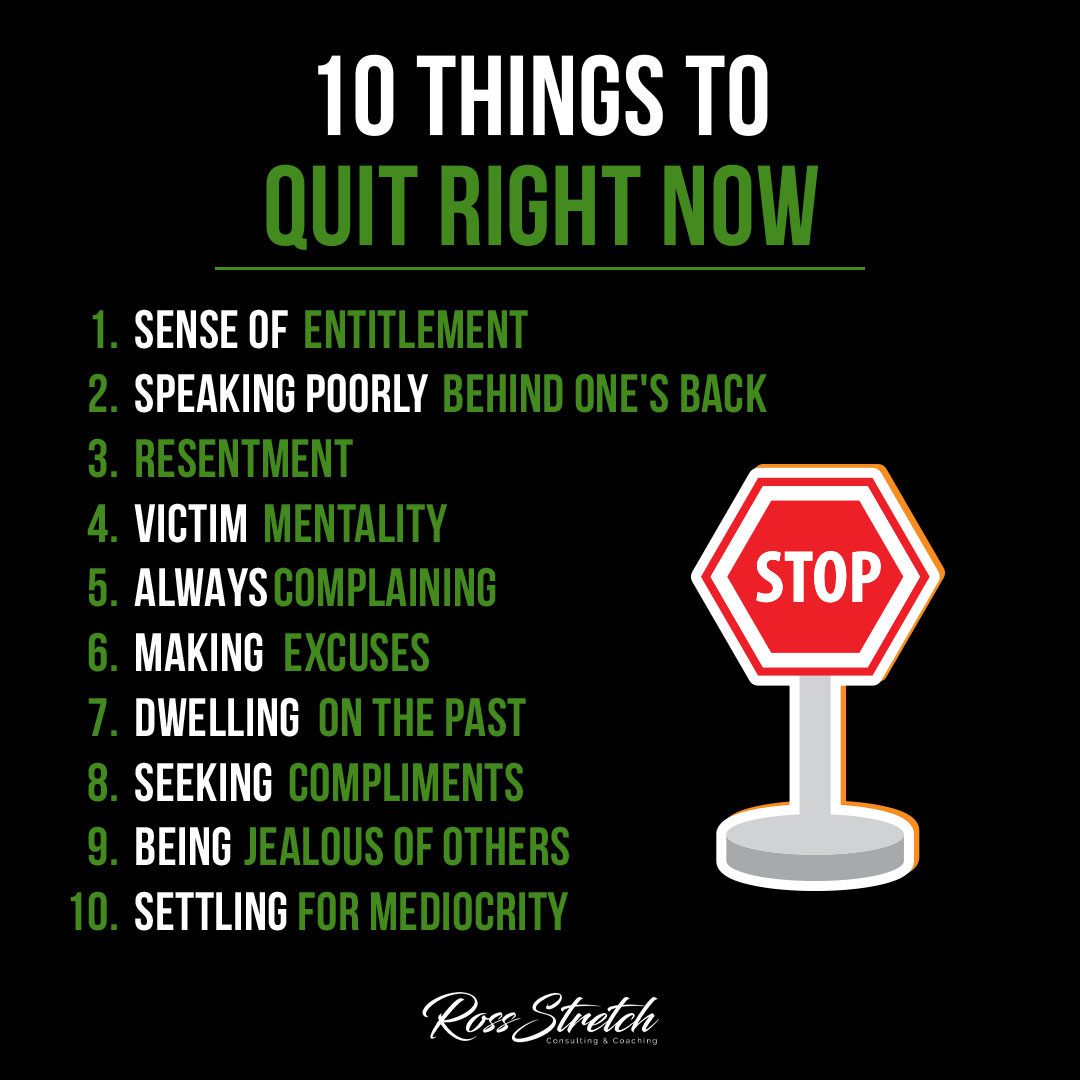
Your habits are not just routines — they are the architecture of your future. The behaviors you repeat daily quietly shape your outcomes in business, relationships, and finances. While building good habits matters, eliminating toxic patterns is often the faster lever. What holds most people back is not the absence of positive behaviors — it is the active presence of destructive ones that drain energy, credibility, and momentum every single day. Here are ten habits worth quitting now, with concrete strategies for replacing each.
1. Entitlement: Expecting Rewards Without Earning Them
Replace the Expectation of Being Owed With a Commitment to Earning
Entitlement — the belief that success is owed to you regardless of effort — kills careers and relationships quietly. It breeds resentment of those who advance through visible work and creates a reluctance to perform tasks that feel beneath your perceived status. The more you expect things to come easily, the less prepared you are when they don’t.
- Actionable Tip: Start each day by identifying one way to deliver value to a client, colleague, or customer without expecting immediate recognition. Track this for 30 days.
- Why It Works: People who consistently add value before expecting return become trusted and well-compensated over time. Entitlement shrinks your world; a service orientation expands it.
Pro Tip:
Use gratitude journaling as a cognitive reset — actively identifying what you have earned access to recalibrates your internal expectations and makes genuine effort feel natural rather than optional.
2. Gossip: The Habit That Quietly Destroys Credibility
What You Say About Others Reveals More About You Than About Them
Gossiping feels harmless in the moment but systematically erodes your reputation over time. The people you gossip with remember that you gossip — and they will not trust you with sensitive information or important opportunities. Gossip also biases your worldview toward the negative, making you less likely to spot opportunities for genuine connection.
- Actionable Tip: Apply the “would I say this if they were standing here?” test before speaking about someone absent. If the answer is no, redirect or opt out of the conversation entirely.
- Why It Works: People instinctively trust those who speak well of others — and distrust those who don’t. Eliminating gossip is one of the fastest ways to elevate how you are perceived.
Pro Tip:
When a conversation defaults to talking about people, redirect it toward ideas, goals, or challenges. This positions you as someone who leads conversations upward — a quality that gets noticed by the right people.
3. Resentment: The Weight You Carry That Only Hurts You
Letting Go Is Not About the Other Person — It Is About Your Freedom
Resentment requires continuous mental rehearsal of past injustices, consuming bandwidth that could be directed toward building something meaningful. The person you resent is rarely affected by your anger — but your focus, creativity, and decision-making are. Held resentment also distorts perception, making it harder to assess new situations accurately.
- Actionable Tip: Write out the resentment in full — the situation, what you felt, what you wanted, what actually happened. Getting it on paper reduces its psychological grip and often reveals a less absolute story than the one you have been carrying.
- Why It Works: Externalizing resentment removes it from your internal processing loop. Many people find writing it out once is enough to genuinely set it down.
Pro Tip:
Frame forgiveness as a practical decision: “I am releasing this because carrying it costs me more than it is worth.” That framing makes follow-through more durable than waiting until you feel ready.
4. Victimhood: Surrendering Agency Over Your Life
Reclaim the Narrative and the Power to Change Your Circumstances
A victim mindset — the belief that circumstances and other people are primarily responsible for your outcomes — guarantees stagnation. It removes the motivation to try, because trying implies believing your effort matters. It also attracts sympathy from the wrong people while repelling those who could help you grow.
- Actionable Tip: For any situation where you feel stuck, ask: “What one thing can I do right now — regardless of what anyone else does — that would improve this even slightly?” Act on it. Repeat daily.
- Why It Works: Agency is a muscle. Small consistent acts of ownership rebuild the internal belief that your choices matter — and that belief is the foundation of every meaningful outcome.
Pro Tip:
Audit your language. Victim language is passive: “things happened to me,” “I had no choice.” Agency language is active: “I chose,” “I will.” The shift feels small but reorients your entire relationship with your circumstances.
5. Chronic Complaining: The Habit That Solves Nothing
Redirect the Energy You Spend on Problems Toward Solving Them
Identifying a problem is useful. Rehearsing it repeatedly without moving toward resolution is not. Chronic complaining signals to others that you see problems clearly but won’t address them. Over time it shapes your environment and mood in consistently negative ways, making the next complaint more likely.
- Actionable Tip: Adopt a simple rule: every complaint must be paired with at least one potential solution. If you cannot identify one, the complaint is not ready to be voiced yet.
- Why It Works: Pairing complaints with solutions changes your relationship to problems — you begin solving them instead of rehearsing them, which is far more appealing to everyone around you.
Pro Tip:
Try a 24-hour no-complaint experiment. Before voicing anything negative, ask whether it moves the situation forward. Most people are genuinely surprised how often their default answer is no.
6. Making Excuses: The Enemy of Accountability
Own Your Outcomes and Unlock the Ability to Learn From Them
Excuses protect the ego from discomfort — but at a steep cost. Attributing failures to external factors insulates you from the feedback that makes improvement possible. It also signals to the people around you that you cannot be counted on when circumstances get difficult.
- Actionable Tip: Use the “what’s my 10%?” framework. Even when external factors dominate, identify the portion of the outcome within your control, examine it honestly, and determine what you’d do differently.
- Why It Works: Taking ownership of even a small portion of an outcome restores agency and produces actionable information — far more useful than a clean excuse that explains failure without preventing the next one.
Pro Tip:
Build accountability structures — a partner, mentor, or peer group you report commitments and outcomes to regularly. External accountability makes excuse-making socially costly, which is often enough to eliminate it as a default response.
7. Dwelling on the Past: Trading Your Future for a Replay
Extract the Lesson, Release the Story, Move Forward
Reflection is purposeful — you revisit an experience to extract insight and apply it forward. Dwelling is cyclical — you replay the same memories and regrets without arriving anywhere new. The longer you dwell, the more memories distort to reinforce the emotional narrative you are already living inside.
- Actionable Tip: When a past event surfaces repeatedly, write down its single most valuable lesson and one action you can take this week to apply it. Then give yourself permission to stop revisiting the event.
- Why It Works: Turning rumination into structured reflection satisfies the mind’s need to “do something” with a memory while preventing it from becoming a draining loop.
Pro Tip:
Future journaling — writing about your goals and the version of yourself you are building — is one of the most effective tools for breaking the dwelling habit. It redirects your narrative from what was lost toward what is possible.
8. Seeking External Validation: Building on Someone Else’s Foundation
Build the Internal Standard That Makes Outside Approval Irrelevant
When your sense of worth depends on others’ opinions, you hand control of your emotional state to everyone around you. Approval-seeking makes it difficult to make decisions that are right for you when they might invite criticism — and creates a trap where every accomplishment must be externally validated to feel real.
- Actionable Tip: Before seeking feedback, write your own honest assessment first. What works? What doesn’t? Practice trusting that assessment, refining it with outside input only after you’ve consulted yourself.
- Why It Works: Developing your own evaluative voice builds confidence to act on your own judgment — essential for any creative or entrepreneurial work involving genuine uncertainty.
Pro Tip:
Distinguish between useful feedback and approval-seeking. Feedback from people with relevant expertise improves your work. Asking “is this good?” without an improvement objective just makes you dependent on other people’s moods.
9. Jealousy: Spending Your Energy on Someone Else’s Race
Transform Envy Into the Motivation to Build What You Actually Want
Jealousy redirects your attention from your own path toward monitoring and resenting someone else’s. It poisons your ability to build genuine relationships with people who could otherwise be your collaborators or mentors. And it reinforces a zero-sum worldview — the belief that someone else’s success diminishes yours — which is almost never true.
- Actionable Tip: When jealousy surfaces, write down what specifically you admire about the other person’s situation. Then ask: “What would I need to do over the next 12 months to build something similar?” Convert the feeling into a blueprint.
- Why It Works: Jealousy contains real information about what you genuinely want. Redirecting it toward goals transforms a destructive emotion into a productive one — their success becomes a proof of concept for yours.
Pro Tip:
Make a habit of genuinely congratulating others on their wins. This trains your brain to associate others’ success with positive emotions rather than threat responses, gradually making jealousy a less frequent visitor.
10. Accepting Mediocrity: The Comfortable Path to Regret
Set a Standard for Yourself That You Are Actually Proud to Meet
Mediocrity rarely announces itself — it arrives as reasonable compromises. A job that pays adequately but offers no growth. Work that is good enough but not your best. Choices made for comfort rather than alignment with your actual goals. The danger is not that it feels bad — often it feels fine. The danger is the cumulative cost over decades, and the regret that comes from recognizing what you never attempted.
- Actionable Tip: Define what “doing my best work” looks like in your career, relationships, and health. Then audit your current behaviors against that standard and identify three specific gaps to close this month.
- Why It Works: Clarity about your personal standard transforms excellence from a vague aspiration into a measurable target. Anything below that standard becomes a conscious choice rather than a default drift.
Pro Tip:
Raise your environment. The people around you normalize certain levels of effort and ambition. Spending time with people who operate at a standard you genuinely respect gradually recalibrates your own sense of what is possible and what is acceptable.
Conclusion: Subtraction Is a Strategy
Personal growth is often discussed in terms of addition — more skills, more habits, more effort. But subtraction is equally powerful. Removing the ten habits above clears the space in which real growth happens. You do not need to address all ten at once — identify the two or three that function as your current biggest constraints and focus there first. Progress compounds quickly because each eliminated toxic habit restores time, energy, and credibility you can immediately redirect toward building something better.
Resources

 Ross Stretch