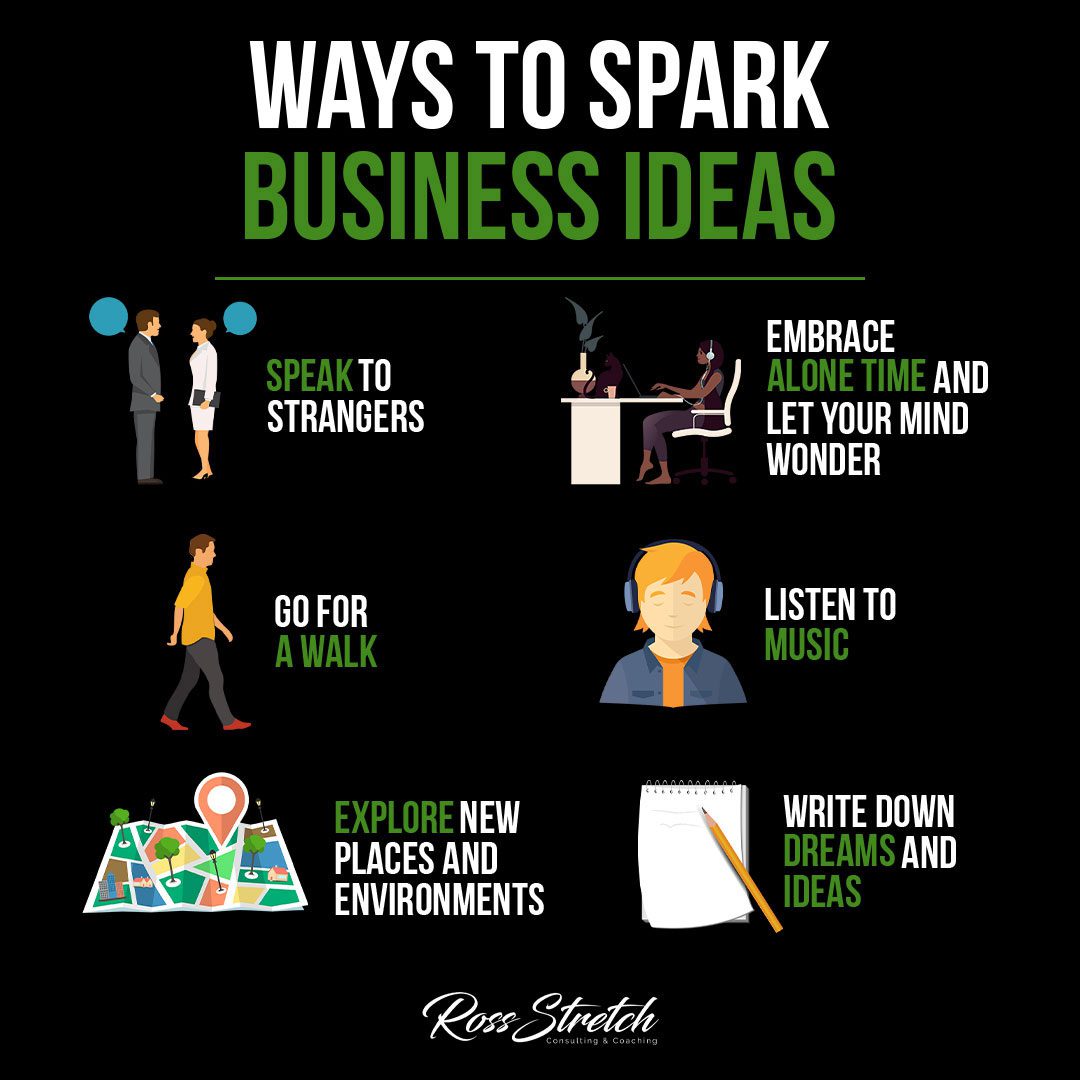
The best business ideas rarely emerge from staring at a blank whiteboard in a conference room. They come from deliberate creative practices — habits and rituals that prime your mind to notice opportunity, make unexpected connections, and generate insights that others miss. Whether you’re building your first venture or looking to pivot an existing one, these six proven methods will consistently fuel your entrepreneurial thinking and help you develop the idea generation engine that separates great founders from good ones.
1. Speak to Strangers
The Most Underrated Market Research Tool Available for Free
Every conversation you have with someone outside your immediate circle is a window into a world of problems you didn’t know existed. The best entrepreneurs are obsessive listeners — they treat casual conversations with strangers as free, real-time market research. The next great business idea might be hiding in a complaint a stranger makes at a coffee shop or a frustration mentioned at a networking event you almost skipped.
- Actionable Tip: Commit to one intentional conversation with a stranger per week. Attend a local networking event, industry conference, or community meetup — somewhere outside your usual circles. Lead with curiosity: ask what problems frustrate them most in their work or daily life. Listen without trying to sell or solve. Write your observations immediately after the conversation while they’re still fresh.
- Why It Works: Human brains are pattern-recognition machines, but they can only work with the data they receive. When you limit your conversations to the same industry peers and social circles, your idea generation is bounded by a narrow dataset. Strangers introduce entirely new variables — new industries, pain points, and cultural contexts — that trigger novel associations your existing network can never provide.
Pro Tip:
Use LinkedIn’s connection culture strategically — send five requests per week to people in industries completely unrelated to yours, with a genuine note about why their field interests you. A 15-minute virtual coffee with someone in a field you know nothing about can fundamentally rewire how you think about your own market. Cross-pollination of ideas is where true innovation lives.
2. Embrace Alone Time and Let Your Mind Wander
Why the Best Ideas Come in Silence, Not Strategy Sessions
Modern entrepreneurship is aggressively noisy — Slack notifications, podcast queues, back-to-back meetings, and social media feeds compete for every available moment of attention. In this environment, genuine solitude is the rarest experience an entrepreneur can have. That quiet is not empty; it is precisely where your most original thinking lives and where half-formed ideas finally find their shape.
- Actionable Tip: Block one 60-minute “mind wandering” session into your weekly calendar — no phone, no laptop, no agenda. Sit quietly, doodle, stare out a window, or do a simple repetitive task like washing dishes or folding laundry. Keep a notebook nearby to capture whatever surfaces. Don’t force ideas; create the conditions where they can arrive without pressure.
- Why It Works: Neuroscience research on the brain’s default mode network (DMN) shows that this system — responsible for creative insight, future planning, and self-reflection — is most active during unfocused, undirected mental states. When you are constantly consuming content or responding to demands, the DMN stays suppressed. Alone time switches it back on and lets it do its best work.
Pro Tip:
Consider a quarterly “solo thinking day” — a full Saturday with no meetings, no social media, and no external obligations. Many entrepreneurs report that their clearest strategic thinking and most innovative ideas emerge not from their busiest weeks, but from their most intentionally quiet hours. Volume of input is not the same as quality of thinking.
3. Go for a Walk
The Cheapest Creativity Tool in Any Founder’s Arsenal
A landmark Stanford study found that walking increased creative output by an average of 81% compared to sitting at a desk. Some of history’s most prolific thinkers — Darwin, Beethoven, Nietzsche, Steve Jobs — used daily walks as an essential part of their creative practice, not as a break from it. Walking and thinking are not opposites; for the entrepreneurial mind, they are partners.
- Actionable Tip: Replace your next brainstorming session or “thinking meeting” with a walking meeting. Take your phone on speaker for collaborative calls, or walk alone and dictate voice notes into a phone app. Aim for at least 20 to 30 minutes at a comfortable, unhurried pace — fast enough to raise your heart rate slightly, slow enough to let your mind roam freely.
- Why It Works: Physical movement increases cerebral blood flow and elevates levels of norepinephrine and serotonin — neurotransmitters associated with improved mood, attention, and cognitive flexibility. The rhythmic nature of walking also has a mild meditative effect that quiets the analytical, problem-focused mind and opens space for associative, connective thinking where new ideas actually form.
Pro Tip:
Change your walking route deliberately and often. Your brain becomes habituated to familiar environments and stops processing them actively. A new neighborhood, park, or commercial district sends a constant stream of fresh visual stimuli that cross-wires with whatever problem you’re mulling — and that cross-wiring between the familiar and the new is exactly where novel ideas originate most reliably.
4. Listen to Music
How Sound Shapes Thinking and Unlocks Creative Potential
Music isn’t background noise — it’s an active input that shapes your cognitive state, emotional tone, and problem-solving approach. The right music at the right moment can shift you from analytical to associative thinking, from anxious to focused, from depleted to energized. Entrepreneurs who understand how to use music strategically have a powerful lever that most people leave entirely untouched.
- Actionable Tip: Build three distinct playlists for three types of cognitive work. First, a Deep Focus playlist of instrumental music at 60 to 80 BPM for analytical tasks requiring sustained concentration. Second, a Creative Brainstorm playlist of ambient or mildly upbeat tracks that build positive mood without demanding attention. Third, an Energy Reset playlist of your highest-energy favorites for transitions between major work blocks.
- Why It Works: Research published in the Journal of Consumer Research found that moderate ambient noise levels — around 70 decibels — enhance creative performance compared to silence or loud noise. Positive mood induced by music also broadens cognitive scope: you literally consider more possibilities when you feel good. Music is a precision mood-management tool with measurable creative returns.
Pro Tip:
Explore genres completely outside your comfort zone as a deliberate creativity exercise during brainstorming sessions. Unfamiliar music forces your brain to actively process something genuinely new, which primes it for novel thinking more effectively than music you’ve heard hundreds of times. Spend one brainstorming session per month with music from a culture or genre you’ve never seriously engaged with.
5. Explore New Places and Environments
Environmental Novelty Is the Original Creativity Hack
Your brain is a prediction machine — it builds mental models of familiar environments and runs on autopilot in spaces it knows well. That efficiency is useful for execution, but it is the enemy of original thought. New environments break those autopilot patterns and force your brain into active, curious processing — exactly the state in which creative connections form most readily and business ideas crystallize from vague impressions into concrete concepts.
- Actionable Tip: Once a month, conduct your most important creative or strategic thinking in a completely new environment — a different coffee shop, a library reading room, a museum café, a botanical garden, or a city neighborhood you’ve never explored. The goal is not comfort; it is productive disorientation. Notice what questions arise that never surface in your usual workspace.
- Why It Works: Research on cognitive flexibility consistently shows that exposure to novel environments activates exploratory thinking and reduces cognitive rigidity. Travel in particular has been shown to boost creative problem-solving — not because of what you see, but because navigating unfamiliarity rewires your default assumptions about how things work, which transfers directly into how you see your own market and customers.
Pro Tip:
You don’t need to travel internationally to capture the benefits of novelty. Deliberately visit a business in an industry adjacent to yours — a hospitality flagship, a retail concept store, or a trade show in a sector you’ve never explored — and study how they solve customer problems. Bring those solutions back to your own context. Cross-industry thinking is one of the richest and most consistently underexploited sources of genuine innovation.
6. Write Down Dreams and Ideas
The Capture System That Turns Fleeting Sparks into Fundable Businesses
Your unconscious mind is solving problems while you sleep, shower, and commute — but without a capture system, most of that work evaporates within seconds of surfacing. Some of the most important businesses ever built began with an idea that arrived at an unexpected moment. The founders who built them shared one habit: they wrote it down immediately, without judgment, and created a system to revisit what they’d captured.
- Actionable Tip: Keep a dedicated idea notebook — physical or digital, whichever you’ll actually use consistently — within arm’s reach at all times. Capture every idea immediately, without filtering or editing. Schedule a weekly 30-minute “idea review” session where you revisit everything you captured and look for patterns, connections, and concepts worth developing further. Treat this session as a standing appointment with your future business.
- Why It Works: The act of capturing ideas reinforces the neural habit of generating them — your brain learns that ideas are valued and worth surfacing, and it produces more of them over time. Ideas also build on each other: a half-formed concept from three weeks ago may complete itself when read alongside something captured yesterday. The notebook is not a graveyard; it is a compost system that turns raw material into fertile ground.
Pro Tip:
Keep a separate “bad ideas” section in your notebook and fill it without shame. Many breakthrough innovations started as ideas that seemed ridiculous in their first form — Airbnb sounded absurd when first pitched. The habit of capturing without editing means you never prematurely kill an idea that might, with time and iteration, become something genuinely significant. Judgment is for later. Capture is for now.
Conclusion
Generating powerful business ideas is a skill, not a gift — and like any skill, it improves with deliberate practice and the right environment. These six strategies work not because they are magical, but because they consistently create the conditions your brain needs to think originally: novelty, rest, movement, connection, and reflection. Build these habits into your weekly routine and treat idea generation as the discipline it is. The ideas will follow.
Resources
- Stanford News: Stanford Study Finds Walking Boosts Creativity
- Harvard Business Review: Why Creativity Is a Numbers Game
- Scientific American: Let Your Brain Breathe — The Importance of Mind Wandering
- Psychology Today: Music and the Brain


 Ross Stretch